
Does Your Athletic Program Need Mental Health Support or Mental Performance Training?

Quick answer: (mental health support - mental performance training) Most programs need both, and they are not the same service. Mental health support is clinical care for an athlete who is struggling. Mental performance training is coaching in focus, composure and recovery for the whole roster. A required coach training course covers neither one fully. |
If you run an athletic program, you have probably had some version of this conversation in the last year. Somebody raised athlete mental health, everyone agreed it mattered, your coaches completed a training module, and the item came off the list. Then the season started and nothing about how your teams actually handle pressure changed.
That is not a failure of intent. It is a mix-up between two different services that get filed under the same heading.
Mental health support is care for the athlete who is struggling. Mental performance training is coaching for the whole roster. Most programs have bought the first and assumed it delivered the second. |
The short version for a busy Athletic Director
Mental health support is clinical, confidential, and delivered by a licensed professional. It is for the athlete who needs care.
Mental performance training is developmental and coached on a schedule — attention, arousal control, routines, recovering from mistakes. It is for everyone on the roster.
Eight states now require coach mental health training. It builds recognition, not performance skills.
A provider who is both licensed and sport-specialized can cover the handoff between the two.
You can pilot the performance side with one team, inside the practice plan you already have, and measure it.
Our coaches completed the mental health training. Is that enough?
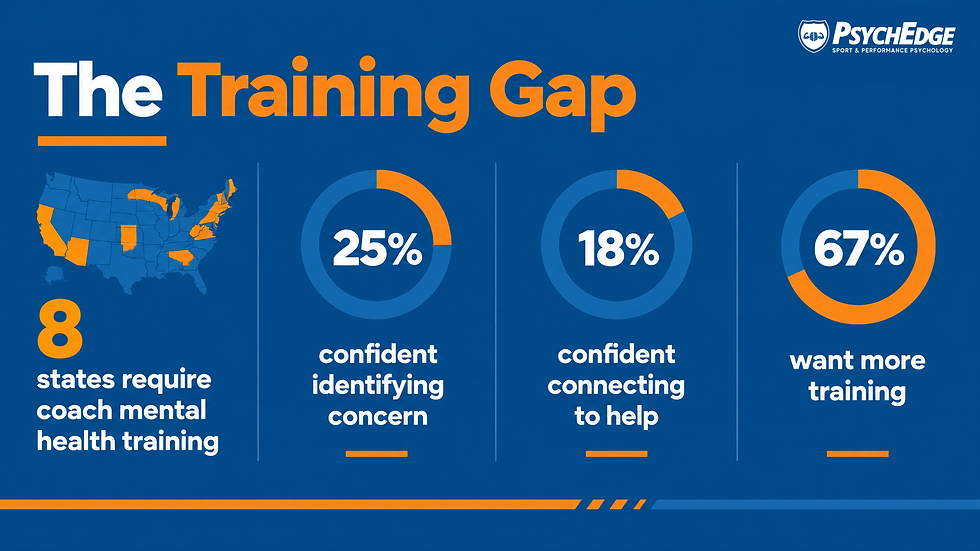
It is a real and necessary step, and it is not the whole job. A review by the University of Connecticut's Collaboratory on School and Child Health found that eight states — Alabama, Arkansas, Colorado, Idaho, Indiana, Missouri, Ohio and Rhode Island — now require mental health training for high school coaches. Five mandate the NFHS Student Mental Health and Suicide Prevention Course specifically; three accept an equivalent. Illinois is not currently among them, which means Illinois programs adopting this are choosing to, not complying.
The same review measured what that training actually leaves behind. Only 25% of coaches said they felt confident identifying a mental health concern in an athlete, and just 18% felt confident connecting that athlete to help. Two thirds — 67% — said they wanted more training.
So, the honest read is this: your staff has been taught to notice. They have not been given anything to run on a Tuesday with ninety athletes who are perfectly well and still losing to their own nerves. That is a different course, and nobody has assigned it.
What is mental performance training for a high school or college team?
It is mental skills coaching, not therapy. The content is the mental side of competing: where attention goes under pressure, how to run a pre-performance routine, how to reset inside the same game after a mistake, how to self-manage emotion, and how to build confidence that doesn't depend on the last result. It is taught in short repeated doses and practiced, the same way you would teach a defensive rotation.
What it is not: a visiting speaker, a preseason assembly, or a motivational session in week one. Those feel good and leave nothing behind by week eight. The test of a real program is whether anything is still being used at the end of the season, and whether anyone can tell you what changed.

Who should deliver it — and what credentials should we require?
This is where schools get tangled, because three different professionals use overlapping language. It is worth being precise, since you are contracting someone to work with minors.
Mental performance coach (often CMPC). Trains skills — focus, routines, confidence. No clinical license required. Excellent at the performance side; not qualified to treat what sits underneath it.
Licensed counselor, social worker, therapist or psychologist. Can treat anxiety, depression and burnout. Holds a state license and is accountable to a board. May have no background in sport, which shows quickly in a locker room.
Licensed and sport-specialized. Less common, and the combination that solves a school's real problem: the same person can run the performance curriculum and recognize, credibly, when an athlete in front of them needs clinical care instead.
Whichever you choose, ask for four things in writing: the state license or certification and its number, experience with your athletes' age group and competitive level, a clear statement of where their scope ends and a referral begins, and current background-check clearance (through licensure) for working with minors.
Sarah's perspective “The single most common conversation I have with schools starts with a district telling me, rightly and proudly, that every coach completed the mental health module. Then I ask what happens at practice on Tuesday for the athletes who are perfectly well and still tightening up when it counts — and there is no answer, because nobody was ever given one. Compliance is a floor. It was never designed to be the program. I hold a clinical license and I specialize in sport and performance, and the honest reason that combination matters to a school is not credentials on a page. It is that the person teaching your athletes routines on Tuesday is qualified to notice on Thursday that one of them is not okay, and to say so to the right adult.” |
How much practice time does team mental skills training take?
If the answer is more than a few minutes, it will not survive a bad week, and it should not. A workable weekly footprint looks like this:
A five-minute video lesson. Athletes watch the video and have an accompanying reflection page to help them process for up to 15 minutes once a week.
One athlete reflection page with an optional weekly tracker. One-page reflection page to help athletes process the 5-minute video as they follow along. Optional tracking page to use for the week to be consistent and form the habits needed to support mental performance.
One coaching cue script. A one-page coaching script with exact wording to say and exercises to reinforce the week's lesson.
Roughly fifteen minutes a week in total. Programs that stick are the ones that add a habit to an existing practice rather than adding a session to an existing schedule.

How do we know whether it worked?
Ask this early and ask it of anyone you are considering, because the honest answer separates a program from an event. Most mental training in schools measures nothing, which is exactly why it does not survive the next budget cycle.
The workable version is an assessment run before the program and again after, using the same instrument both times. In the Performance Potential Program (P3) that is the PMPI, scored across eight dimensions, and what the school receives at the end is a team report: where the group started, how many took the assessment, where it finished, and which skills actually moved. The dimension that did not move is often the most useful line in the report, because it tells you what to coach next season.
How do we start without adding a staff position?
You do not need a line in the budget to begin, and you should not start district-wide. Hiring a full-time licensed sports psychologist is a six-figure commitment that most districts cannot carry, and it is not the only route.
Start with one team and one season. Pick a program whose coach is interested, fit the weekly footprint above into the practice plan they already have, run the assessment at both ends, and see what you get. A pilot you can observe and measure is what turns an idea into something you can take to a principal, an athletic council or a board — and it is a far easier conversation than asking for a new position on the strength of a brochure.

Frequently asked questions
What is the difference between mental health support - mental performance training?
Mental health support is clinical care — anxiety, depression, burnout — delivered confidentially by a licensed professional to an athlete who needs it. Mental performance training is skills coaching in focus, composure, routines and recovery from mistakes, delivered to a whole roster on a schedule. Schools need both, and a coach training course in one does not cover the other.
Do high school coaches have to take mental health training?
In eight states — Alabama, Arkansas, Colorado, Idaho, Indiana, Missouri, Ohio and Rhode Island — yes. Five require the NFHS Student Mental Health and Suicide Prevention Course specifically and three accept an equivalent. Illinois does not currently require it, so Illinois programs adopting it are doing so by choice.
What credentials should a school require for mental performance training?
Ask for the state license or certification and its number, experience with your age group and competitive level, a written statement of where their scope ends and a referral begins, and current background-check clearance for working with minors. Someone both licensed and sport-specialized can cover both the coaching and the referral.
How much does mental performance training cost a high school?
It varies widely by model. A district-employed licensed sports psychologist is generally a six-figure annual commitment, while contracted consultants typically bill hourly. A single-team pilot on a curriculum model is the least expensive route and the easiest to justify, because it produces measurable results before anyone is asked to fund a rollout plus you have access to someone who is both licensed and sport-specialized to cover both the coaching and the referral.
Is this therapy? What do we tell parents?
No. Mental performance training is skills coaching and is not confidential clinical treatment. Tell parents exactly that, name who is delivering it and what their credentials are, and explain the referral path if something clinical surfaces. Programs that state this clearly up front have far fewer problems than those that leave it vague.
Where to start
If your coaches have completed the required training, you have done the necessary part and you should not be talked out of valuing it. The question worth asking next is what your program gives the athletes — the ones who are well, prepared, and still leaving performance on the field.
That part is teachable, it is measurable, and it starts with one team.
See how P3 runs inside a season — and the Founding Team window: psych-edge.com/p3-performance
Coaches' guide: training the mental game without adding to practice: psych-edge.com/post/mental-training-for-sports-teams-how-to-coach-the-mental-game-without-adding-to-practice
Talk it through — book a call with Sarah: psych-edge.com/booking-calendar/initial-consultation-1
What the different provider titles mean: psych-edge.com/post/sports-psychologist-near-me-how-to-find-the-right-one-and-what-to-expect
Research cited: University of Connecticut Collaboratory on School and Child Health, “Mental Health Training Requirements for High School Coaches” (May 2024). https://www.frontiersin.org/journals/sports-and-active-living/articles/10.3389/fspor.2025.1701426/full

About the author
Sarah Greene-Falk, MS, MA, LCPC
Licensed Clinical Professional Counselor · Sport & Performance Psychology · Founder, PsychEdge
Sarah Greene-Falk is a Licensed Clinical Professional Counselor specializing in sport and performance psychology. For nearly 20 years she has worked with athletes at every level — from youth and high school competitors to collegiate athletes and Olympians — helping them train the mental skills that turn practice performance into game-day performance.
She holds an MS in Counseling Psychology and an MA in Kinesiology & Health Sciences with a specialization in Sport and Performance Psychology, both from the University of Northern Colorado, and is a Licensed Clinical Professional Counselor in Illinois. Sarah is the creator of the Performance Potential Program (P3), a 12-week mental performance curriculum used by athletes, coaches, and athletic departments, and of the PMPI — a pre- and post-program assessment that measures growth across P3's eight core mental skills. She works with individual athletes, teams, and athletic departments across Naperville, the greater Chicago area, and virtually — nationwide.
This article reflects Sarah's direct clinical and applied experience with athletes and is grounded in established sport psychology research on attention, arousal regulation, and performance under evaluation.
📍 Naperville, IL · 📞 630-219-0339 · ✉️ sarah@psych-edge.com Read Sarah's full bio → · Book a free discovery call →


